

Jeju is one of the best places in Korea to explore by car. But if you’re visiting from abroad, rental insurance—especially “CDW”—can feel like a black box: Am I actually covered? How much will I pay if I scratch the car? What if my friend drives? Let’s break it down in a clear, practical way.
1) First: what “CDW” usually means in practice
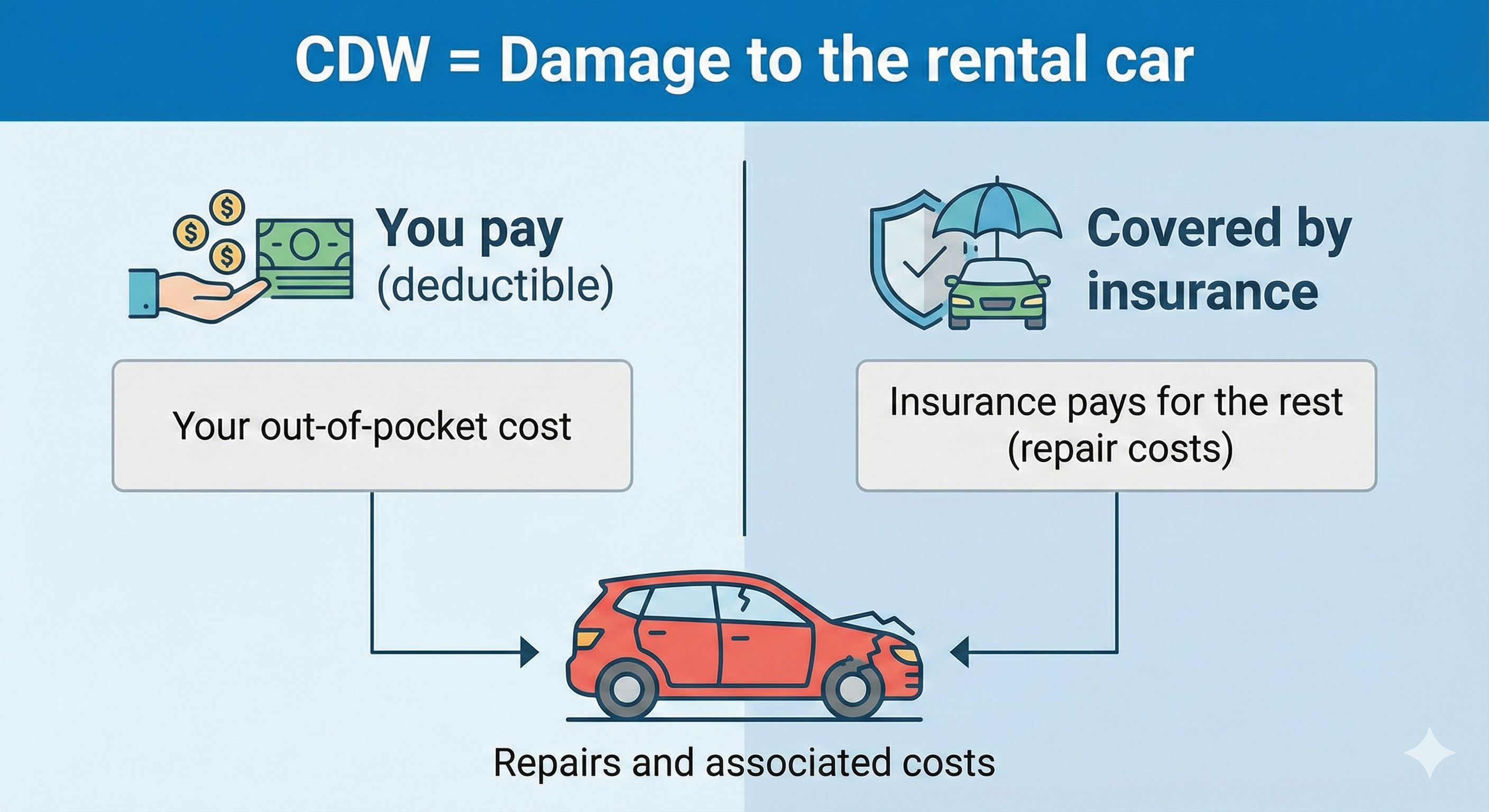
When people talk about CDW (Collision Damage Waiver), they’re usually referring to coverage for damage to the rental car itself—in other words, protection for the vehicle you’re driving.
On your booking details, this is often shown as self-vehicle damage coverage, together with key conditions such as:
Deductible / excess (the amount you still pay out of pocket)
Coverage limits
Whether loss-of-use (downtime) fees are reduced or waived
Because coverage details vary by rental company and insurance option, always check the insurance section on your booking page (for Orcar reservations, this appears in Trips).
2) Two insurance buckets you should understand
Most rental protection can be grouped into two main categories:
A) Damage to the rental car (your vehicle)
This is what travelers usually mean by CDW. If the car you’re driving is damaged—scraping a wall, hitting a curb, or backing into a pole—this coverage helps pay for repair costs. A deductible may still apply.
B) Damage to others (people and property)
This covers:
Injury to other people (pedestrians or occupants of other vehicles)
Damage to other vehicles or property (cars, buildings, structures)
Driver injury (coverage for the driver’s own injuries)
If you book through Orcar, rentals always include basic mandatory protection. You will not be given a car with “no insurance at all.” That said, the exact scope depends on the partner rental company and the option you selected, so reviewing your booking details is essential.
3) The #1 rule foreigners miss: insurance applies only to registered drivers
This is the most common—and costly—mistake. It’s not about nationality; it’s about driver registration.
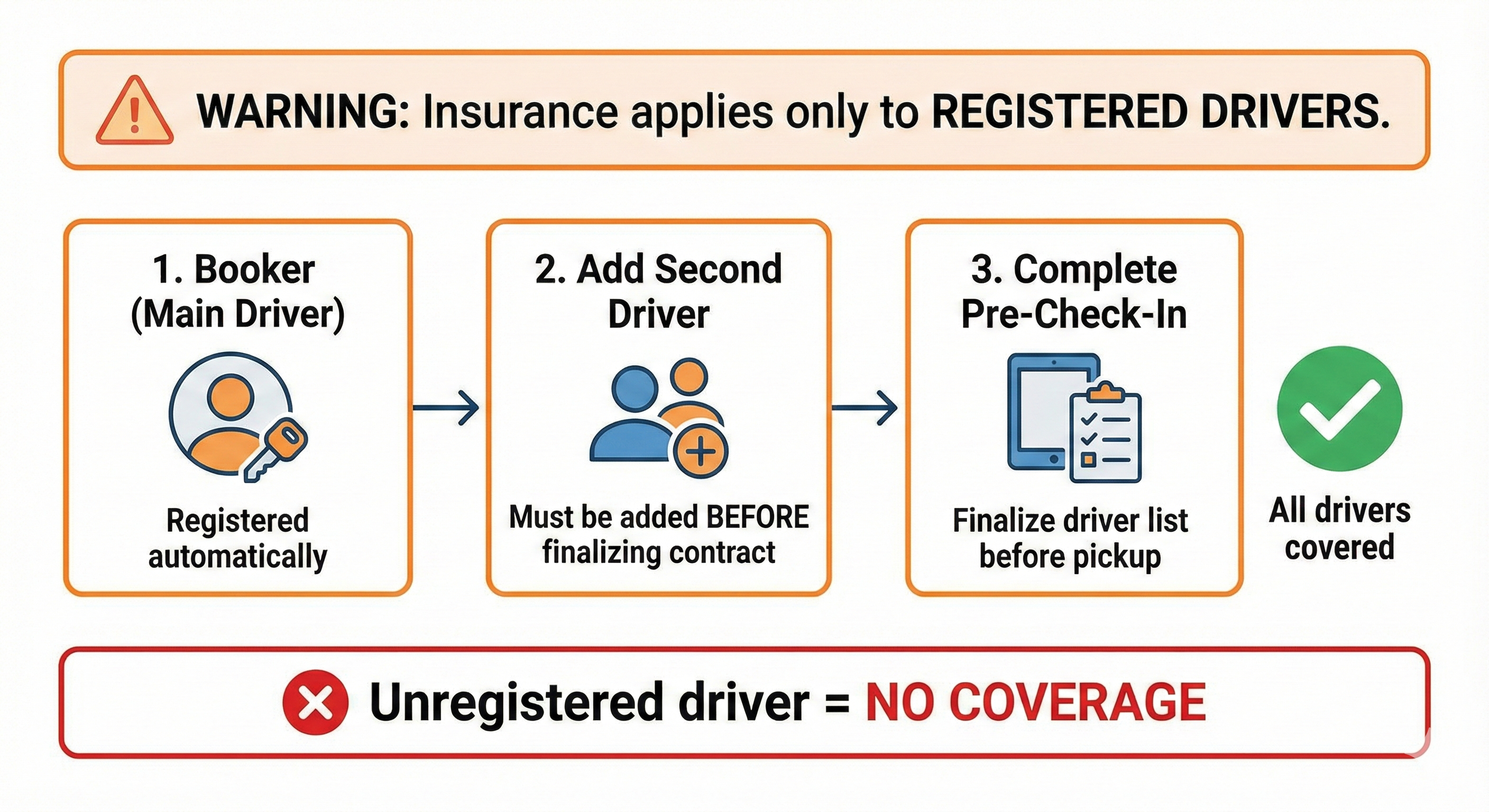
Insurance applies only to drivers registered in advance.
The main driver (the booker) is registered automatically.
Any additional driver must be added as a second driver before the rental contract is finalized.
If an unregistered person drives and an accident occurs, insurance may be invalid. In that case, the driver can be responsible for all costs—including repairs and third-party damages.
Practical takeaway: Even if someone “might drive just once,” register them before pickup.
4) Foreigners can be covered—if your license is valid and accepted
Insurance coverage is available to foreign drivers, but only if your driving eligibility can be confirmed at pickup. You must present one of the following:
International Driving Permit (IDP)
Plus your original home-country driver’s licenseA local driver’s license recognized in Korea with a notarized Korean or English translation
A Korean driver’s license
Important: In all three cases, you must also present a valid passport. Without it, vehicle pickup and insurance coverage may be denied.
Some partner companies do not recognize licenses from certain countries. If eligibility cannot be verified on-site, pickup may be refused. To avoid surprises, review your booking conditions in advance and refer to this related guide: Can I Drive in Korea? 5 Things You Need to Know About Your IDP .
5) Deductible (excess): why “covered” can still mean “you pay”
A deductible is the portion you pay when an accident happens. Insurance does not always cover 100% of the cost.
Example:
Repair cost: ₩1,500,000
Deductible: ₩300,000
→ You pay ₩300,000, insurance covers the rest (within policy terms).
Some plans offer zero deductible, depending on the rental company and option selected. If repair costs are lower than your deductible, insurance may not reduce what you pay.
6) Scratches and minor damage: is it covered?
In many cases, yes—as long as your booking includes rental-car damage coverage and the driver was properly registered.
Deductible ₩300,000, scratch repair ₩200,000 → you may pay ₩200,000
Deductible ₩300,000, repair ₩800,000 → you pay ₩300,000, insurance covers the rest
Minor-damage handling can vary by partner, and additional administrative fees may apply. Always confirm your booking’s specific coverage rules.
7) Loss-of-use (downtime) fees: the charge many travelers don’t expect
If the car cannot be rented out while being repaired, the rental company may charge a loss-of-use fee.
With Orcar bookings, rental-car damage coverage typically includes partial reduction or waiver of this fee, which can significantly reduce your out-of-pocket cost (a deductible may still apply).
8) What to do immediately if an accident happens in Jeju
If an accident occurs, staying calm and following the right steps helps protect both your safety and your claim.
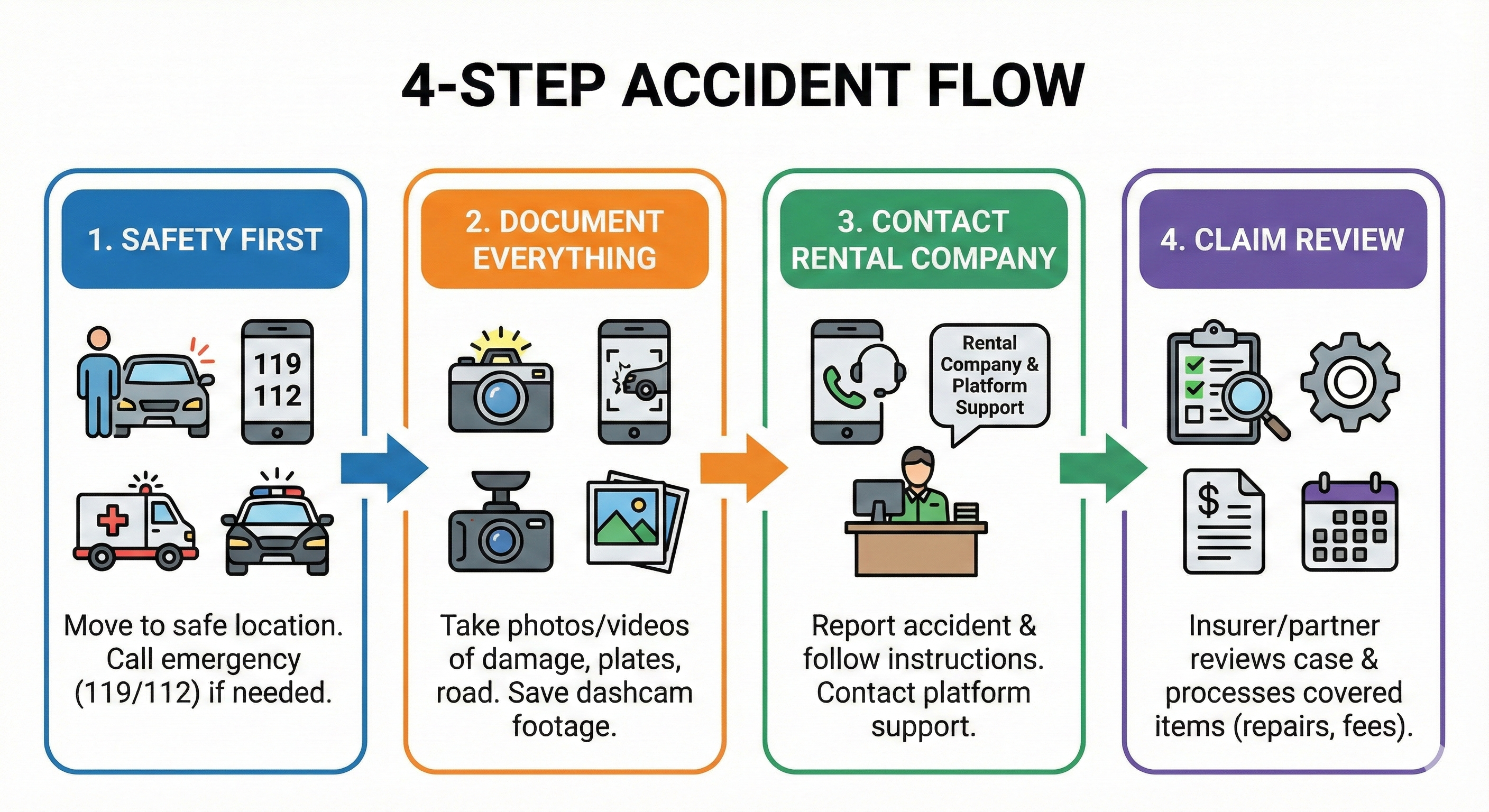
Safety first
Move to a safe location if possible. Call 119 (ambulance/fire) or 112 (police) if needed.Document everything
Take photos and videos of damage, license plates, vehicle positions, and road conditions. Save dashcam footage if available.Contact the rental company (and platform support)
Report the accident as soon as possible and follow their instructions.Claim review
The insurer or rental partner reviews the case and processes covered items such as repairs, medical costs, and loss-of-use fees.
9) Protect yourself at pickup: take photos before driving off
Many Jeju rentals use self-pickup or unmanned systems, which makes documentation even more important.
Before leaving, take clear photos of:
All four sides of the car
Bumpers, mirrors, wheels, and fenders
Any existing scratches or dents
Timestamped photos are one of the strongest ways to prove damage was pre-existing.
10) “Damage was found after return”—what happens?
With unmanned returns, damage may be identified after you drop the car off.
You may receive a damage report with photos.
You can submit your own return photos to clarify the situation.
If payment is processed via the card linked to your reservation, charges are handled according to the booking terms, and notification is typically provided in advance.
11) One more critical detail: some coverage applies to only one accident
Certain rental insurance products are treated as one-accident-only coverage.
After one insured accident, a second accident during the same rental may not be covered.
Insurance usually cannot be added or upgraded after pickup or after an accident.
Some rental companies may require the vehicle to be returned after an accident.
In short: After any incident—even a small one—drive extra carefully.
Quick CDW checklist for foreigners renting in Jeju
Before pickup
✅ Confirm CDW/self-vehicle damage coverage and deductible
✅ Register all drivers in advance
✅ Bring required documents (license + translation if needed, passport, IDP if applicable)
✅ Take pickup photos
If an accident happens
✅ Safety → photos → contact rental company → follow claim process
Want extra peace of mind?
If you’d rather drive Jeju with fewer worries about deductibles, scratches, or unexpected costs, consider booking with Orcar’s premium insurance options from the start.
👉 Check out Orcar and reserve with premium coverage